Vienna ball
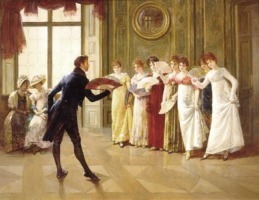 What is actually the typical Vienna ball?
The dancing nights in Vienna were already described in the Middle Ages. For example, in 1247 a big festival continued a whole week, was organized on the occasion of Hungarian King Ludwig the Great visit. In 1470 another Hungarian king, Matthias Korfin, arrived in Vienna to meet Emperor Fridrich III. In honour of the two high-standing persons a Viennese patrician organized a celebration with dances, which was so glamorous that as a result of this fact a plaque was placed on the building situated on Beckerstrasse 1.
Probably even in the Middle Ages there were two absolutely different forms of dancing celebrations. The differences were indicated especially in 17th and 18th century.
There were some elegant balls of the aristocracy where a strict formality was followed. This formality was extremely important during the yearly Palace Ball performed in Spanish style. Some more free manners were not possible and because of the fact that almost without any exception all men were dressed in uniforms and they were not allowed to leave their swords even during a dance.
Besides, there were dancing celebrations for the people which were often organized on the street. Women and men were wearing masks which gave them a free hand.
During the reign of the popular among people Emperor Joseph II began gradually removing the barriers between the dancing entertainments of the aristocracy and the common people. He ordered to be allowed the participation of citizens in the palace ball and he enjoyed the fact that under the cover of the mask some high-standing persons were participating in the celebration of the lower class – sometimes he did the same too.
Centuries on end a new dance has been defining the character of the balls: the Vienna waltz.
From Middle Ages to nowadays dances in three four time have being preferred not just in Vienna but all over Austria and in Bavaria too. The waltz originated from there in 18th century. Its name has derived from the old word “waltzen” which means nothing else but “spinning”. In 19th century the composers of waltz music reached a brilliant level which provided them an honorable place in the great Viennese music tradition. First of them were Joseph Lanner and Johan Strauss – father and son.
The culmination of the Viennese ball history was the Viennese congress 1814/15, when after the end of the Napoleon wars Europe was reforming under an Austrian guidance. More dancing entertainments than political conferences were organized which obviously contributed to the problems settlement. Namely an Austrian diplomat Prince de Linge said: “Le congres danse, mais il ne marche pas.” (The Congress is dancing but does not progress.), but in the final reckoning the Congress – in the meaning that organizers put into that word – brought to a happy end.
In 19th century some specialties of Vienna balls were created. One of them was the gift for the ladies. Nowadays this specialty has already existed.
The special programs were feature of the Vienna balls too. Nevertheless, it was a matter of high art achievement or it is just an artistic, humorous or romantic one, the applauses of the friendly audience were certain.
During the Vienna balls contacts among people were established and maintained. Because of that the Vienna balls were usually organized by communities, from doctors to cafй keepers. Of course, they were performed during the “Fashing” as this period of time was named in Vienna, but in other places it was also called a carnival. Traditionally, the Viennese “Fashing” lasted from the New Year night to the day before Pure Wednesday. If someone wanted to enjoy a ball there were enough opportunities in Vienna before and after the “Fashing”. As a matter of fact the Vienna ball could not be submitted to any standards or rules. It was just a pleasure of dancing under the sounds of a high level music, free for new forms, chance to be close with a touch of intimacy and an opportunity for association with other people.
After the bloody and inglorious end of the revolutionary 1848, nobody cared about dances in Vienna. There were some years until the happiness of life reached that level which made the ball celebrations in “Viennese style” possible to be restored.
In 1862 the famous Theater an der Wien obtained a “royal permission” to organize balls again. Certainly, the attractive Paris Opera balls were taken as a model. The first ball, named “A Ball in the Palace Opera”, was not performed in the building of the “Ring”, or in the new and magnificent building of the “Society of the friends of the music”.
At last in 1877 the Emperor gave permission for “soiree” in his opera.
After the fall of the empire in 1918 the young republic started surprisingly fast remembering for the imperial celebrations in the opera. Still on 21st of January 1921 was performed the first Opera Mask Ball in the Republic of Austria and in January 1935 the first so called “Vienna Opera Ball” was held.
After The Second World War and after overcoming first years of hunger in collapsed Austria in November 1955 the reconstructed Opera was opened officially.
Till nowadays the balls are an integral part of the Viennese carnival “Fashing”. Most of the balls in Vienna are organized in January and February, although first of them start in November and the last of them die down in the end of June and their total number is about 300. The most important among them is the traditional Opera Ball which name originates from the place of ball performance, the Vienna National Opera.
Nowadays the Opera Ball is an impressive holiday of the Republic of Austria.

THE VIENNA BALLS IN BULGARIA
The organizations of official receptions and dinners were initiated in the end of 19th century and were carried to Bulgaria by the new Bulgarian Prince Alexander von Batenberg. The first Vienna ball in Sofia was organized for the new elite of Sofia in the Prince palace on 8th of January 1880. Some of the guests were some wealthy citizens; landowners were also invited as well as some craftsmen without any special education and manners.
The tradition of balls in Sofia was regenerated in 1996 and dancing Vienna waltz started again. Meanwhile the Vienna Ball in Sofia has become a traditional and charity event organized by the Vienna Club Association with the assistance of the Austrian Embassy. Of course, the idea came by Viennese – the diplomats of the Austrian Embassy in Sofia. The first Vienna Ball was organized in the halls of Military club on 17th of February 1996. The organization and performance of such event was not easy and because of that reason a second ball was not followed in the next few years.
In the year of 2000 after a new team of the embassy arrived the initiative was regenerated, but this time the embassy looked for cooperation with the Vienna Club Association. Together with combined efforts and with the support of the municipality of Vienna the next Vienna Ball was organized in Military club again on 17th of February 2001. Since it was decided that the performance of the balls in Sofia should be with charitable purpose, therefore the collected money at the amount of 12 000 BGN was endowed to the Orphan House in city of Vratza and the Orphan House in the village of Roman, Vratza district.
In autumn started the preparation of the next Vienna ball but the municipality of Vienna informed that Vienna days in Sofia would be carried out in October 2002 and they would be glad if the event took part within the framework of their activities. Since the Vienna balls have being traditionally carried out in the period between the New Year and the Pure Wednesday /40 days before Easter/ the Ball became a Charitable Vienna night which was performed in the Sofia Hall of Kempinski-Zografski Hotel. A special delegation leaded by the major Michael Hoepfl arrived from Vienna for participation in the event. The menu was made and prepared by an Austrian chef and an Austrian pastry cook and the decoration was prepared by a Viennese landscape-gardener. This time due to the Vienna municipality was collected the amount of EUR 14 200 with which the establishment of Children Center for Liver Transplantation in the city of Sofia was supported.
At last on 22nd of March 2003 was organized the already traditional Vienna Ball in Sofia, in Kempinski-Zografski Hotel again. It could be considered that the balls in Sofia are in Viennese style because of the observance of the major components characterizing this event. Even guidance for organizing Vienna balls is written, since the municipality of Vienna has recognized this holiday as its reserved brand which makes popular all over the world. As everywhere else as in Sofia, the Vienna Ball welcomes its guests with a glass of wine and presents for the ladies and after that comes the turn of inauguration by the debutants dancing “Polonaise of the fan” by Ziehrer. Of course, the typical Vienna waltz is not missed and as well as classic dance music by Austrian composers. Of course, the dances continues to dawn but they are not only under the sound of classic music and because of that another orchestra for modern dance music is engaged, so everybody who does not feel very confident in the dance of polonaise or “left” waltz, for example, could entertain themselves too.
Another obligatory component of the Vienna ball is the midnight program. The guests have the chance to have some rest enjoying the performance of famous Austrian operettas presented by soloists and ballet-dancers of the Music theatre and the National Opera accompanied by their good colleagues of the orchestra.
During all that night tickets of the raffle are being sold which is one of the methods for collecting funds for the charity idea of the ball. With the collected money of the third Vienna Ball amounting to 15 000 BGN has been bought some medical appliances for N. I. Pirogov Multispecialized Hospital of Active Treatment and Emergency Medicine.